Tuesday, 1 June 2010

This was the highlight of the project because the kids’ reaction to the experiment it was as close to the results I will see. I guess the final results would be a more complete way of educating them science but that would be harder to see.
The adjacent picture showed a single sheet of A4 paper could hold up 1kg (900ml water and beaker) of mass. I did not know that can happen but they enjoyed it. This experiment was just a bit of ‘fun’. No-one got epically wet and no beaker smashed. I should have used the plastic beaker. I only had paper on that day. I tried.
I was going to tell them about Euler buckling but I doubt I would gain any respect points from that.
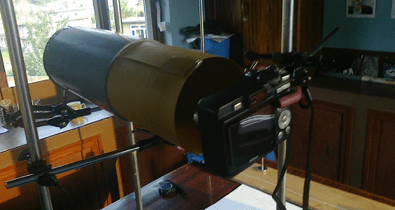
This was a WOOOO. The pinhole camera. They did not understand why the image was upside down and why lens were not needed. Also the zoom in function by sliding the inner tube outwards. Obviously everything became clearer (excuse the visual pun) when I drew the diagram for the two cases.
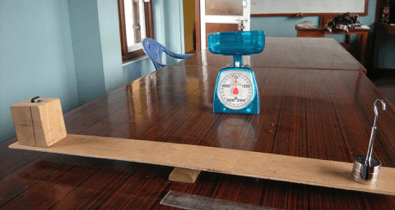
I got another WOOOO here. This was the principle of moments. The key here is that the unknown mass (wooden block) is 30cm (0.3m) away from the pivot (fulcrum in Nepali) and 300g (0.3kg) is a certain distance away from the pivot to balance the system. By matching the weight and the length I eliminate the need of calculators in this experiment. Them being kids, I guess the most impressive thing for them was that might not have been the demonstration of principles of moments. It would be that they did not need to use a calculator to work anything out. Which is a good thing in Nepal because not every kid have one.
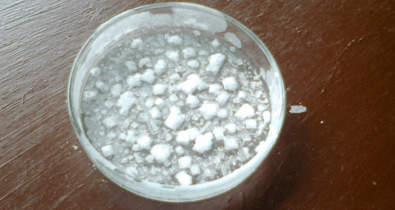
This was the WAAAAAAAAAA. Actually it was the reaction from the science teacher first!!! He never seen anything like this before, unreal. I explained to him that it was just salt (sodium chloride). He just didn’t believe me because he never saw salt in that form. Then I had to explain to him. “You thought you need to heat it by bunsen burner to force the water away to leave the solid salt behind. But it does not give the salt enough time to form crystals. However what I did was made sure the solution was saturated in room temperature by dissolving as much salt as I can and filtration to remove the excess salt hence crystals can form immediately as water evaporates slowly. Evaporation gives bigger crystals because more time is allowed for the salt molecules to slide and fit together perfectly, eventually result in big crystals. (I can’t remember the exact term I used) He then showed his class and they spent a good 15 minutes looking at table salt. Funky square crystals.

 Adventures of Delboy
One thought on “Entry 23 Kids Reactions”