Entry 110 – I am not stuck here with you. You are stuck here with me… Now let’s play.

Delays after delays.

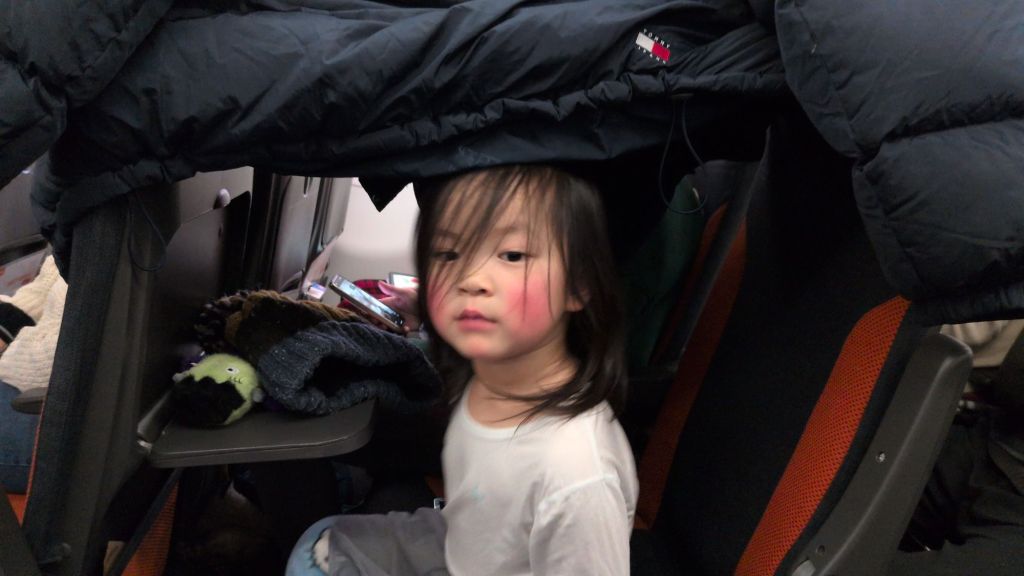
The first delay was a two hour delay before take off. Everyone was a bit upset but Sophia knew more time to play. She drew with me, sang quietly, played with her neighbours and made a tent. She survived without any screen time which was a surprise. Nowadays digital screens are part of our lives. Old school play pretending is still fun and her brother done a great job in playing together.

She showed me that I should be more happy with delays. I was exactly where I should be with any delays with her.

Her tent had to be removed prior to takeoff.

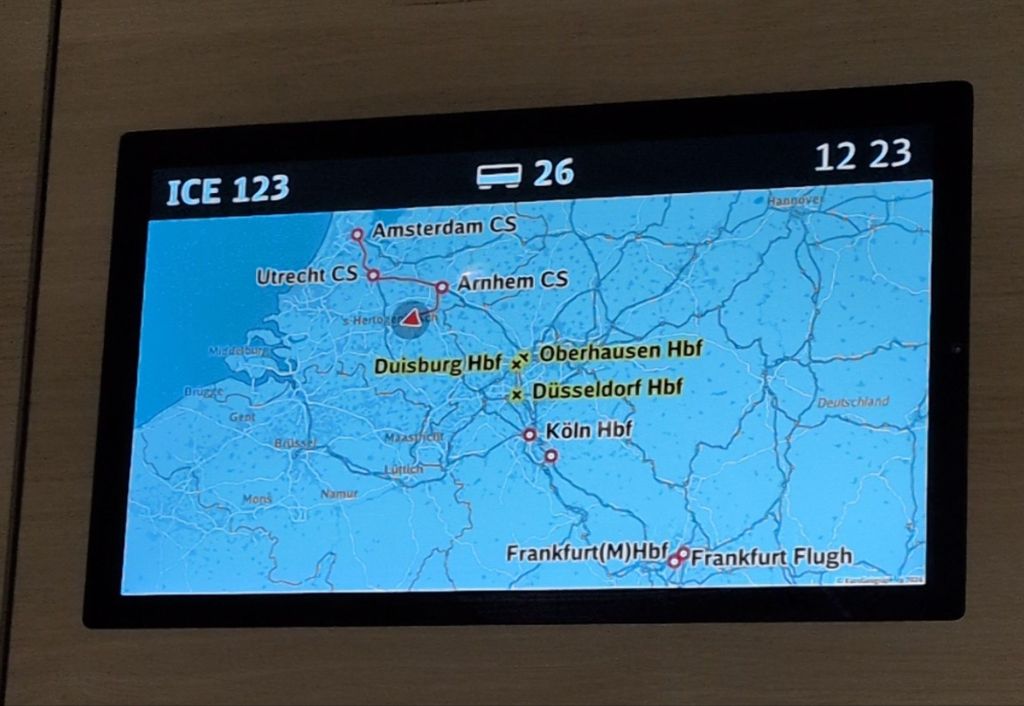
The second delay was on a train where we wanted to go to Dusseldorf. Fortunately for Sophia, yay! 2 hour delay! The lady next to her will play together. Nowadays, most people in this situation will go to their phone and wait begrudgingly for the train to get to the destination but for Suzanne today was not one of those days…

oh yes, we are more delayed and the train is moving away from our destination. Let’s play together.
We are not stuck in the train. You are stuck here with me. Now let’s play together.

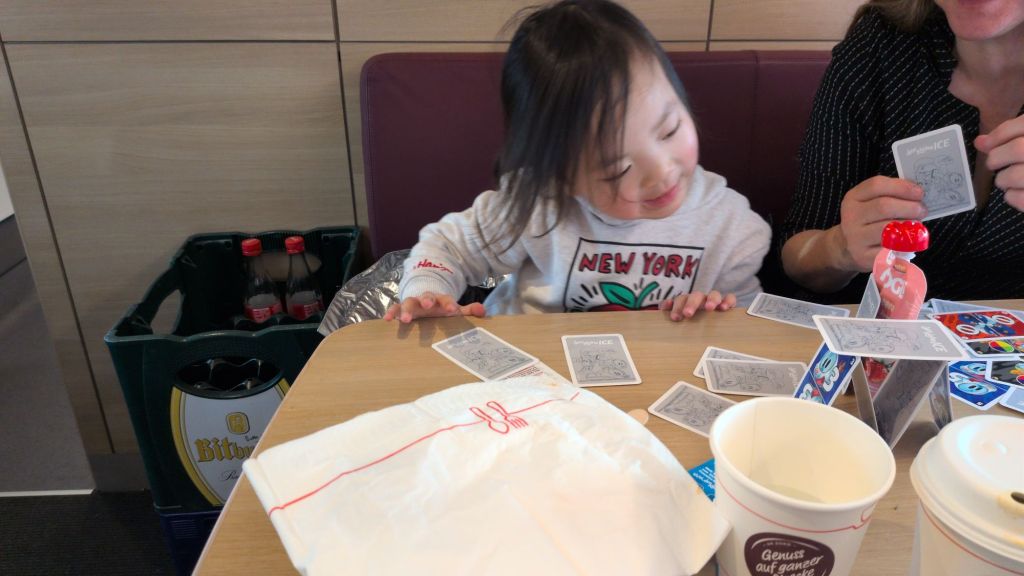
Suzanne had nowhere to go. She just had to play. Sophia rattled through all her games, introduced her zombie baby to her new friend, played Uno on her rules, asked Suzanne the colour of every card, had a Lego tea party with Bluey, made train track with the cards… and then repeat just as Suzanne thought she earned some screen-time. No Suzanne you are stuck with me. Now let’s play together.

I was a little concerned that we effectively looked like doing pretend shots, and I was very concerned when Sophia worked out where she can pretend refill her bottle of pretend drink, so many rounds passed during this delay.

Hopefully Suzanne has recovered by now.

Entry 109 – How I travel with my 3 yrs old.

Solo travel with Sophia

My Christmas holidays started later this year. I get to take Sophia to Europe by myself. The journey is memorable so it is going onto my blog.

Preparations

A princess does not travel lightly. She will need her butler (me), her porter (me), her donkey (me) and her daddy (me). so I have to be prepared to carry her, her bag and my bag.

She knows that a ‘Cappuccino’ starts the day well.

Early cappuccino X2 for the extra boast

Coming up…

I am not stuck here with you. You are stuck here with me. Now let’s play together…

Cultured old town stroll and not Disneyland.

Entry 108 – A letter for 10 years later. – updated one year later (10%) 9 more years to go.

What will the world be like?

I think the majority of my blog entries aged kindly for me. There were not many controversial topics, travelling and volunteering are fun experiences to share from 2010 (15!! years ago). I am new to a parenting blog. Let’s write about what will happen in 10 years. Hopefully, I will be 10 years older. I am not sure what type of world will be after 10 years, better or worse, but it is the only world we will have. Labour are in power. Politics are more divided than ever. So let’s summarise what I am doing and revisit in 10 years’ time.

After one year, I only kept the BE A Scholar Tuition project for my young children. I might be asking for a lot of qualities; have their own artistic style in a portfolio, music around grade 8 with two instruments at 13, inspired by the Sciences, read and write proficiently, multi-lingual, have numerous passions, excel at Mathematics, enjoy sports and be confident in themselves. The focus is how to gather the motivation to reach them.

In 10 years’ time

BE a Scholar Tuition

Update 1 year on – I developed the concept further one year on. The value is more clearer and key performance indicators are well defined. The King’s scholarship’s academic level defined the goal of a competitive private education outcome at 13 years old. Assuming a private education at £24k a year for 5 years from 8 years old. I will provide an alternative path to reach that level for selected subjects. £120k does not guarantee a child’s success at scholarship level for all 8 subjects. The hypothesis is that with parental support, child’s motivation and a fraction of the subject, we can achieve a highly competitive level.

I hope to create an environment where people can succeed in whatever they want to do. I believe that will lead to a better and kinder world. So I continued with my education blog, BE a Scholar Tuition. Each child’s aspiration is the focal point and the focus is to make studying enjoyable to reach their goals. So in 10 years’ time, I hope lots more people grow up and able to achieve their aspirations. I have created a group to do that.

McRobotface Club

This year has had some ups and downs for the Robotics Club. One-off sessions were more popular. I think the expectation is that Robotics should be part of the National Curriculum offered by schools, which I agree with to an extent. However, I think technology would have moved on by the time the National Curriculum is updated, and that local schools would have the resources to implement it properly and unlikely to happen with this government. I wanted to guide kids to explore emergent behaviours, which I think uses the full potential of the educational robots. My aspiration level is to reach the Harvard Postdoc, inspired by my PhD supervisor. I am going to put this on hold. However, BE a Scholar Tuition may revisit this project.

I created the McRobotface Robotics club to introduce robotics to the local families. The most successful ones are the family sessions, where parents enjoyed playing the educational robots with their 5 to 7-year-olds. The parents work with their children and the children can show remarkable concentration time from 30 to 1 hour. That is what parents remarked. So hopefully, these kids will be inspired into robotics and create robots that benefit the society.

Meetup groups

Update – These are closed down because they are costly to run. Meetup organising requires a budget and finance. I gave it a go. I played more chess with my 8 yrs old. I travelled with my 3 yrs old, which is really fun.

I am also trying to be more sociable both for my 2 year-old and my 7 year-old through Meetup groups. Check out this Meetup event from “Dads with 3 year olds or younger”. I am determined to keep her with me during these formative years. So I can provide the social aspect and not constrained to the same nursery or school.

“Dads with 3 year olds or younger”:– Link to Group

I also created a Family board game group for the older kid. Link to group

I also play my part at Little Plaza, which is our aim to create a Little corner for our children to grow up, with arts, music, STEM, and many possibilities. http://www.littleplaza.co.uk So I do wonder what I will write in 10 years time.

Entry 107 – McRobotface Update 1

Now let the music starts

#Robotics #STEM #Afterschool #Edinburghkids #kids #Cognitivedevelopment

The McRobotface crowdfunding finished with 2 robots, so I am able to move onto the next step. I am very grateful to the funders for their support, shout out to the guy from Japan who I helped 10 years ago in Italy during his travels. I tracked him down using Facebook, easier than it sounds and it was very kind of him to pledge.

The first step is to start understanding and playing with the robots. The age range is from 4 to 13, which is covered by VEX 123 and VEX Go. The sessions will have an introduction with philosophical questions like what is a robot? how does a robot work? Why is a robot? We will find the answers through a journey through educational robots at the club.

Origins of the club.

A 6 year old boy wrote to his headmaster asking for new toys for the class because the construction toys were old and broken. Not much happened. So I wanted to show him a way to take action and make a difference to the educational environment. These educational robots existed for 3 years, as evidenced by the Youtube videos through my research. So in Edinburgh, we are basically more than 3 years behind some random schools in the US which runs robotics competition. So the club will narrow the gap to just 3 years behind. I will look at how to further close the gap. McRobotface Robotic Club will document a journey to understand STEM educational robot development to move from being completely left behind to three years behind in the first step and then subsequently closer to the frontier of research. It turns out my PhD in robotics will help.

Let’s establish the club.

The club currently has two robot platforms. Some clever people already made a lot of research and testing for the VEX 123 and VEX Go, so let’s just play with them as they intend to. There is a finite number of hours for a child to understand what the platform does.

In my educational blog, I believe in more importance in asking questions than answering questions,

VEX 123 – Age 4 onwards (to 7)

This is a simple robot for kids. The robot has lights, sounds, and can move forward, turn left and turn right. I adapted a series of 5 sessions for this age. The robot really fits with Piaget’s model of children cognitive development, like people who designed it had the model in mind. I personally like the screen free coding approach. I look forward to uncovering the endless possibilities that coding a loop can provide.

  • Symbolic Thinking: Children can use the coding tiles to connect the symbols to the robot’s movement.
  • Egocentric Thought: Children can understand the “3rd person” perspective by coding the robot to interact with the environment.
  • Intuitive Thought: Children can develop their intuition to predict and test what will happen to solve a generic problem.

The McRobotface club with VEX 123 has 5 variations of activities to create a journey to introduce robotics to children.

VEX GO Aged 7 onwards to 13

VEX GO is a like LEGO for robots but with fewer variation of parts and set designed plans available like, a car, base robot, robot arm, and linkages. I find it adds an engineering element to robotics. There are broad themes to each sessions, familiarisation (i.e. how does the robot work), problem-solving (do a task), and discovery (how the concept can grow further). There will be a series of 10 activities to cover an academic term for afterschool club activities.

Concrete Operational Stage (7 to 11 year) is where VEX GO’s design is most aligned with Piaget’s cognitive development model:

  • Hands-on Learning; so each session will start with a parts list and build towards a goal, active learning.
  • Logical Thinking; building robots, or robot arms and programming them to perform a task.
  • Sequencing and reversibility, the children will code in sequence, stringing a series of concepts together to perform a task.

The advantage of being hosted by Little Plaza, is that synergy with other activities. For example, there is a “Show and Tell”, where the session can be a “build and tell”, and the children can explain how they get to this solution. Building robots is about experimentation and “Everyday Science” focuses on the Scientific Method which is a fundamental part of science.

It is almost like, the designers had Piaget’s children’s cognitive development model in mind when they created these educational robots. McRobotface Club will look to introduce every major educational robotics platforms to utilise the uniqueness of each platform. Ozobots and Marty will be added in due course.

.

Personal note

The Robotics Club is like trekking for me, like how the Sherpa showed me Annapurna Circuit Trek and guided me through the sights. 12 days of no stop guiding and each day the altitude and scenery were different. I hope I can be a guide through this particular journey of discovery, like Annapurna Circuit Trek, it is there to be experienced.
Entry 106 – My Parenting / Education Blog so far

I am an Asian parent as mentioned before so naturally, I take my destiny / blessing / curse competitively so let’s recap what I have done.

  1. Looked at King’s Scholarship 13 plus for Eton.
    • I understand what academic standards colleges like Eton are looking for.
    • What is the value?
    • Importance of sports and music to supplement academic achievement
  2. My conclusion is to make the first interview / audition a priority. If one is successful at their first interview, everything else that lead up to the interview seems to be less important.
    • Preparation provides the ingredients and the classical arrangement is the recipe, based on Classical Rhetoric.
    • Understanding failure is part of the process and not the end.
    • What do you want to be part of life? For example, 20% music.
  3. Created after-school activities at Little Plaza with a high standard of input (e.g. from research groups and top university graduates). Experts are out there and talk with passionate people.
    • Reading club with 4 variants of the book review, read a lot of books will prepare writing.
    • Everyday science club to introduce the Scientific Method from the basics to Harvald Post Graduate paper writing inspired by Prof. George Whitesides
    • How to make Maths fun – UKMT to focus on critical thinking. Maths Challenge Questions tend to have multiple way of solving them, which encourage mind-mapping.
  4. Read research papers on children’s cognitive development and discuss with academics at the University of Edinburgh for their insights.
    • Different stages of cognitive development will match different aspects of brain function. Use Piaget’s model as the starting point to focus on suitable things for that age.
    • A balance of different topics takes advantage of brain lateralisation and information causality.
  5. Science of learning, how to maximise grade improvement for every 30 mins of study.
    • Mind mapping and the acausal nature of information play a key part in representing the world around us.
    • Current Difficulty, Context Awareness, Confident Mindset, Concentration and Knowledge Level are important variables to tune for efficient learning.
  6. Crowdfunding to launch the McRobotface Robotics Club
    • Educational robots are widely available (to purchase) but not in use.
    • The next generation will encounter robotics and artificial intelligence, which may even render coding less important. AI can code too.
    • A journey from a single robot to a cluster of robots and robot competitions.
    • Review what the world has to offer, as these robots / toys are already designed.

Entry 105 – The Second Law of Thermodynamics on McRobotface Robotics Club.

#stem #robots #robotclubs #kidsactivities #childdevelopment

Introduction to McRobotface Robotics Club

The McRobotface Robotics Club will start in July 2024. The current forecast is a fund that makes a partial launch possible. Therefore, the club will be more suitable for smaller groups and more 1 to 1 sessions. The educational robots will be suitable for children ages 4 to 11. The McRobotface Robotics Club is about getting children to learn about robotics via playing in a structured environment.

The McRobotface Robotics Club journey

The McRobotface Robotics Club will become an integrated STEM development service provider for children aged 4 to 13. The McRobotface Robotics club will provide the robot hardware from different manufacturers (starting from Vex due to the age range) then the next step will be to add Robotical’s Marty, which is a humanoid and a more expressive robot. The training documentation will be reviewed and adapted for the children and instructions for their accompany adults. The key value is that the magnitude of entry is greatly lowered into hundreds of pounds to tens for parents and eventually competition will reduce from thousands of pounds to a few hundreds for schools and groups.

Every journey starts with taking the first step, crowdfunding provided the first step and will see how the community react.

The Second Law of Thermodynamics applies.

These educational robots are like LEGOs and everything else subjected to the Second Law of Thermodynamics. The Second Law of Thermodynamics basically states that the entropy either increases or stays constant in a given process. Entropy is essentially a measure of disorder and in this case, when the educational robots are new, the entropy is at its lowest. Entropy will increase as soon as the packaging is removed. The process is for the kids to play and learn about robotics. after every play, the best case is for the robot to stay “nearly new” and the entropy stays constant. However, there is a chance that parts are broken and the entropy increases. The Second Law of Thermodynamics is in action here.

I will have to spend time and resources to maintain the robots. Adults are required Instructions are required to enable the educational robots to be used properly and to deliver the learning points. Therefore the challenge is to optimise the time and resources, and training to ensure entropy stays constant.

Entry 104 – Motivation for the Robotics Club

I want to start this Robotics Club because…

  • I want to show my children that to make a difference to our environment, one should try and take a small step.
  • The first step to do something is always difficult but not impossible.
  • The robotic hardware and instructions already exist and the logical step is to use them. This is not rocket science.
  • It is ok to ask for help. There are friends, local communities, experts, research groups and organisations that can help and achieve the goal.
  • I educate myself within the Additional support needs (ASN) group about their needs and it would even help me to learn more about myself. So it is important to learn about different aspects of society.
  • Playing with education robots is a great way to developing computational thinking, from age 4 onwards to 11.
  • Be curious and find out how things will go, and even in failure be persistent and dust yourselves down and try again in a slightly different way for a different outcome.
  • I want to show my children that it is possible to create something valuable the inspiration for a child and the clear difference between impossible and improbable.

Considerations for the Initial Launch club.

The Robotics Club sessions can be highly customisable which means the current forecast will be ideal for small groups. Educational robots can be a great option for ASN groups. Every child is different so parental involvement is important. The value is potentially discovering a new interest for the child. My aim is to provide a (1) calm environment, (2) functional robots (not a box of parts), (3) clear instructions and learning goals. The initial period is about finding the mean time between failure (MTBF) and mean time to be inspired (MTBI) for the children. The two variables, the price of the robots, experts’ time and venue costs will make provide all the numbers needed a viable robotics club that can lasts a long time.

For Autism Spectrum Disorder (ASD), the following 10 points are taken into considerations.

  1. Clear structure and routine: Use of existing documentation to establish a consistent schedule and routine for the robotics club, including designated times for activities, breaks, and transitions. Use visual schedules or visual timers to help participants understand and anticipate what will happen next.
  2. Sensory considerations: Be mindful of sensory sensitivities and provide a sensory-friendly environment for participants. Use soft lighting, minimize noise, and have another room ready where children can retreat if they become overwhelmed.
  3. Structured activities: Design robotics activities that are structured and goal-oriented, with clear instructions and expectations. Break tasks into manageable steps and provide visual supports such as diagrams or step-by-step guides to assist participants in completing tasks successfully.
  4. Small group settings: Keep group sizes small to provide a more intimate and supportive setting for children with autism. This allows for more individualized attention and facilitates meaningful social interactions with peers and mentors.
  5. Visual supports: Use visual supports such as visual schedules, visual instructions, or pictograms to aid communication and comprehension. These supports can help children with autism better understand tasks and activities and reduce anxiety or confusion.
  6. Peer modeling and collaboration: Encourage peer modeling and collaboration by pairing children with autism with neurotypical peers who can serve as role models and mentors. This provides opportunities for social learning, imitation, and cooperative problem-solving.
  7. Individualized support: Provide individualized support and accommodations based on the unique needs of each participant. This may include personalized instructions, adaptations to activities, or additional assistance from mentors or support staff as needed.
  8. Positive reinforcement: Use positive reinforcement and praise to motivate and encourage participants throughout the robotics club. Celebrate achievements and progress, no matter how small, to build confidence and self-esteem.
  9. Social skills development: Incorporate social skills activities and group discussions into the robotics club to help participants practice and improve their social communication, teamwork, and cooperation skills.
  10. Parent involvement: Foster collaboration and communication with parents or caregivers to ensure continuity of support and reinforce learning outside of the robotics club setting. Provide resources and strategies for parents to continue supporting their child’s interests in robotics at home.

And for AHDH children, the following will be considered.

  1. Structured routine: Establish a consistent schedule and routine for the robotics club, including clear start and end times for activities, as well as scheduled breaks. Use visual schedules or timers to help participants understand the flow of the club and anticipate transitions.
  2. Engaging and hands-on activities: Plan hands-on robotics activities that are engaging and interactive, with opportunities for exploration and creativity. Incorporate elements of choice and autonomy to allow participants to pursue their interests and maintain engagement.
  3. Clear instructions and expectations: Provide clear and concise instructions for activities, and break tasks into manageable steps. Use visual aids such as diagrams or demonstrations to help illustrate concepts and expectations. Check for understanding and provide reinforcement for following directions.
  4. Flexible learning environment: Allow for flexibility in the learning environment to accommodate different learning styles and preferences. Provide options for movement and physical activity, such as standing desks or fidget tools, to help participants stay engaged and focused.
  5. Positive reinforcement: Use positive reinforcement and praise to motivate and encourage participants throughout the robotics club. Recognize and celebrate achievements, no matter how small, to build confidence and self-esteem.
  6. Peer collaboration: Encourage peer collaboration and teamwork by pairing participants together to work on projects or solve problems. Provide opportunities for cooperative learning and shared decision-making, which can help foster social skills and build relationships.
  7. Break tasks into manageable chunks: Break larger projects or tasks into smaller, more manageable components to prevent overwhelm and promote success. Set clear goals and deadlines for each step, and provide support and guidance as needed.
  8. Sensory considerations: Be mindful of sensory sensitivities and provide a sensory-friendly environment for participants. Minimize distractions such as noise and visual clutter, and offer sensory breaks or quiet spaces where participants can recharge if needed.
  9. Encourage movement breaks: Allow for frequent movement breaks to help participants release excess energy and maintain focus. Incorporate opportunities for physical activity or stretching throughout the club to support concentration and engagement.
  10. Flexibility and patience: Be flexible and patient with participants, recognizing that they may have different needs and challenges. Provide support and encouragement, and be willing to adjust activities or approaches as needed to ensure that all participants can fully participate and enjoy the robotics club experience.

Entry 103 – McRobotface Robotics Club

Let’s give it a go.

https://www.crowdfunder.co.uk/p/mcrobotfaceroboticsclub

McRobotface Robotics Club

The last 10 years saw huge development in robotics and interest in STEM subjects. My son returned home one day and told me that the toys at school were broken and old. I realise this might be the case for other schools. The aged equipment environment might have been good in the past. However, times move on and the environment should move as well. Therefore, I decided to try and launch an initiative to provide affordable robotics sessions run by experts to provide an inspirational environment.

The first step is often the hardest step

Step 1, get some robots that are educational and age-appropriate.

Step 2, get kids and their parents to play and familiarise with the robots and the coding.

Step 3, get some educational material and understand what they may learn to make the play relevant.

Step 4, go to a Robotics research group (my previous one is a start) and engage some experts to explain and guide the sessions.

Step 5, get more kids and parents involved to do more complex robotics challenges and arrange team competitions. Parents can sit back and relax, job done.

Step 6: Get the research groups to modify the standard education material to react to the latest research trends, making the sessions more relevant and exciting.

Step 7, repeat 2 to 6.

This is my master plan. I just have to start.

Motivation

14 years ago, I visited the Peace Garden School just because I stayed in the local suburb outside Kathmandu. There was a science lab with microscopes and heaps of slides and cover slips but no-one wanted to use it. I created a series of experiments, to demonstrate simple scientific principles. My favourite bit was to show that one does not need to follow the textbook rigidly to boil off the saturated salt water to extract salt crystals, it would be a huge waste of energy. Evaporation would grow the crystals bigger. Even the teachers were impressed.

https://wordpress.com/post/delbot1234.co.uk/124

Crowfunding can invite the community to take part to create something that lasts the test of time. Let’s give it a go.

Entry 102 – I made a new Artificial Intelligent friend.

I have started using AI to learn more information.

Mindfulness is the latest buzzword in education. So let’s ask AI to write about it.

Below is what my new AI friend wrote. Interesting.

Introducing Mindfulness to a Child

Introduction

Mindfulness is a practice that can help children develop skills that will benefit them in many areas of life. It can help them cultivate self-awareness, become more focused, and better manage their emotions.

What is Mindfulness?

Mindfulness is the practice of focusing on the present moment and being aware of our thoughts, feelings, and environment. It is a way to help children become more aware of the present moment and learn how to manage their emotions.

Benefits of Mindfulness

Mindfulness can have many benefits for children. It can help them become more aware of their thoughts and feelings, be better able to focus, and better manage their emotions. It can also help them become more resilient, have better impulse control, and be more creative.

Introducing Mindfulness to a Child

When introducing mindfulness to a child, it’s important to start small and make it fun. Try activities that involve focused breathing, such as blowing bubbles, playing with a pinwheel, or drawing on the ground with a stick. It’s also important to explain why mindfulness is important and how it can help them in their day-to-day life.

Conclusion

Introducing mindfulness to a child can be a great way to help them develop skills that will benefit them in many areas of life. It can help them become more aware, learn how to manage their emotions, and be better able to focus. By starting small and making it fun, children can learn to appreciate the practice and find it helpful.

Entry 101 – Yesterday is history…

“Yesterday is history, Tomorrow is a mystery, Today is a gift. That is why it is called the present.” Master Oogway. That’s deep. Enjoy each day…

Master Oogway is so wise. There is a chance that my education approach is based on Kung Fu Panda (Copyright Dreamworks). I certainly just watched it. What is the secret ingredient? It is always there within the child. Just have to find the BEST version of themselves. We just have to look harder.

What other movies should I base my education approach on? Please leave a comment. Maybe these movies are good for getting some ideas into their subconscious minds. I am off to watch Kung Fu Panda 2 for more wisdom. Mind blown…

Yesterday is history, so today, check out my BE a Scholar Tuition (BEST) website and enjoy your day. Subscribe for tomorrow’s mystery and a future full of possibilities.